Hire Less, Automate More: A Smarter Way to Scale Your Business
Stop hiring your way into complexity. Discover why business process automation saves money, reduces errors, and scales better than adding headcount in 2026.
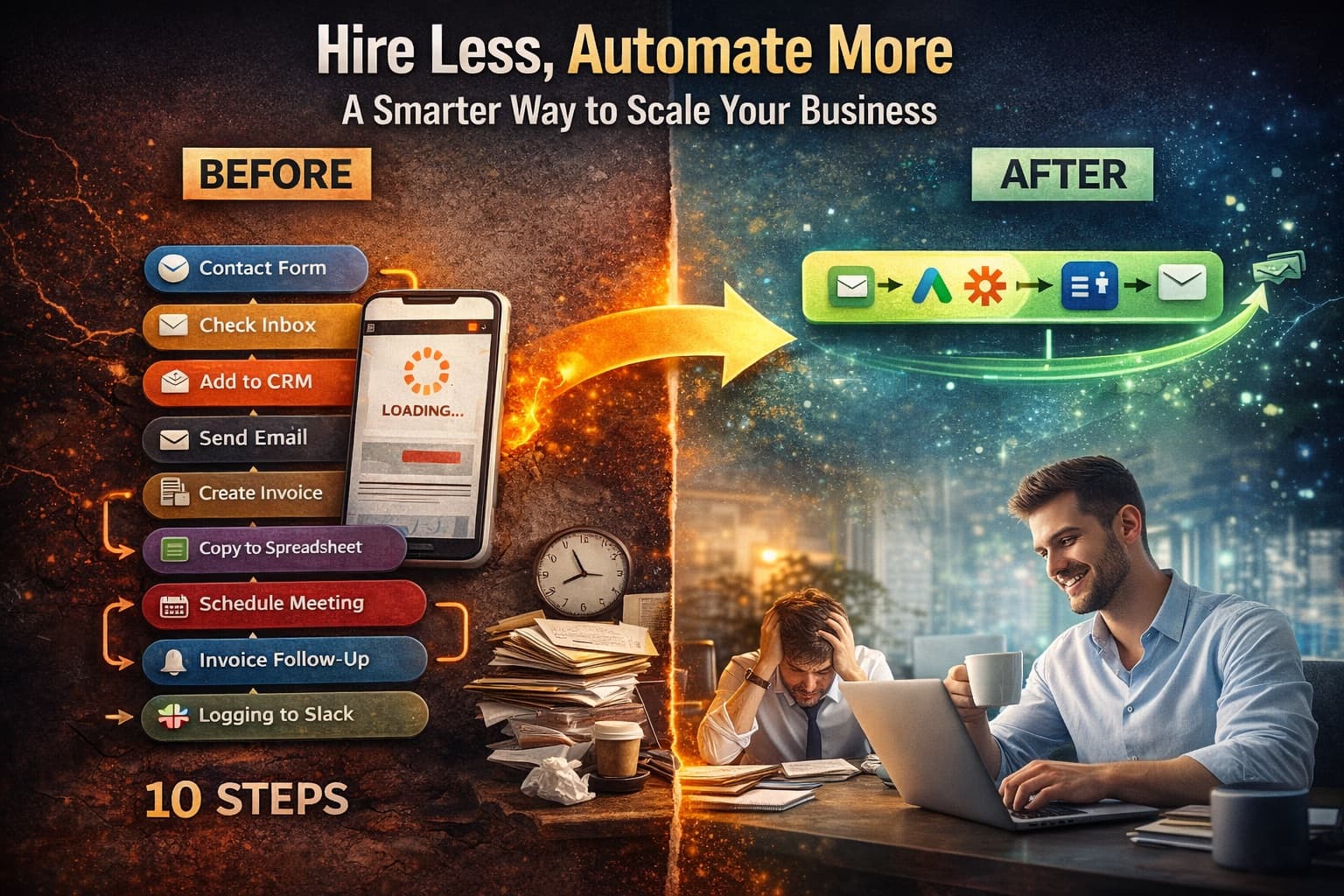
Hire Less, Automate More: A Smarter Way to Scale Your Business
You just landed three big clients in one week. Pop the champagne, right?
But by day three, you’re drowning. Your inbox is a war zone. Someone forgot to send the onboarding paperwork to the new client. Your "system" for invoices is a Google Sheet that’s three weeks behind. And you’re wondering if it’s too late to un-resign from your day job.
Here’s what most founders do next: They panic-hire. They jump on Indeed and start recruiting a $45,000/year admin assistant or a $60,000 operations manager because "we’re growing and we need help."
And honestly? That’s usually the wrong move.
Don’t get me wrong. People are great. But hiring is expensive, messy, and permanent. Once you bring someone on, you’ve got payroll taxes, benefits, training time, and the emotional labor of management. What if I told you there’s a way to handle that growth spike without the HR headache?
Business process automation isn’t about replacing people with robots. It’s about stopping yourself from hiring someone to do mind-numbing copy-paste work that software can handle while your team sleeps.
Let’s talk about why automation almost always beats headcount—especially when you’re in that messy middle between startup and scale-up.
The Hiring Trap (And Why We Fall For It)
There’s something weirdly satisfying about hiring your first employee. It feels like you’ve made it. You’re a real business now with a team. Instagram photos of your “amazing crew” incoming.
But here’s the thing nobody posts about: Employees are fixed costs with zero flexibility. That $50k salary doesn’t shrink when February is slow. That office space doesn’t get smaller when three clients pause their contracts. And the time you spend managing people? That’s time you’re not spending on sales, strategy, or actually enjoying your business.
I watched a marketing agency owner—let’s call him Jake—hire two account coordinators last year because they were “swamped with admin.” Six months later, those coordinators were busy, sure. But they were busy doing data entry, copying information from Typeform into Mailchimp, and manually creating invoices in QuickBooks.
Jake spent $80,000 plus benefits on humans doing work that literally makes them miserable. That’s not growth. That’s just human-powered inefficiency with health insurance.
What Business Automation Actually Looks Like (No Robots Required)
When I say “automation,” you probably picture some sci-fi factory with robotic arms. Or maybe you think of those annoying LinkedIn messages that pretend to be personal but clearly aren’t.
Real business process automation is way less sexy and way more useful. It’s just connecting your apps so they talk to each other without you playing middleman.
Example: A new lead fills out your contact form. Instead of that data sitting in an email you forget to check, automation instantly:
- Adds them to your CRM
- Sends a personalized welcome sequence
- Creates a task in your project management tool
- Adds their info to a spreadsheet for tracking
- Slacks your sales team
That’s five tasks that used to eat up 15 minutes of someone’s day. Now it happens in eight seconds. For free.
And here’s the kicker: You don’t need to know how to code. Tools like Zapier, Make (formerly Integromat), and even native features in your existing software handle the heavy lifting. We’re talking drag-and-drop interfaces, not command lines and Python scripts.
The Math That Changes Everything
Let’s get specific about money because that’s what this audience cares about.
Say you’re spending 10 hours a week on repetitive admin tasks. Onboarding clients, data entry, chasing invoices, scheduling posts. At your effective hourly rate—let’s be conservative and say $100/hour—that’s $1,000 of your time every week. That’s $52,000 a year of you doing work that doesn’t scale your business.
Option A: Hire an admin at $40,000/year plus taxes and benefits. Total cost: ~$52,000. They can do that work, sure. But they also need management, sick days, and bathroom breaks. And when they’re out sick? The work stops.
Option B: Build workflow automation for those same tasks. Upfront cost to set up properly: maybe $5,000-$8,000. Monthly software costs: $150-$300. Total year one cost: ~$8,600.
You just saved $43,400. That’s a new car. That’s six months of runway. That’s a marketing budget that actually moves the needle.
And the automated system doesn’t call in sick. It doesn’t have bad days. It doesn’t accidentally delete a row in your spreadsheet because it’s rushing to pick up kids from school.
Real Talk: What This Actually Fixed for Us
I want to share a specific story because vague advice is useless.
We had a client running a coaching business. She was booking 40 discovery calls a month, and each one required:
- 12 emails back and forth to find a time
- Manual calendar invites
- Copying info into her CRM
- Sending a prep questionnaire
- Following up if they didn’t fill it out
- Reminder emails 24 hours before
She was spending 15 hours a week just scheduling. So she hired a VA for $20/hour to handle it. Problem solved? Nope. The VA was slow, made mistakes with time zones, and honestly looked for a new job within three months because the work was soul-crushing.
We replaced the VA with automation. Connected her Calendly to ActiveCampaign to Notion to Twilio. Now?
- Prospects book instantly based on her real availability
- Confirmation texts send automatically
- Prep forms get delivered via email and SMS
- No-shows get automatic reminders
- Everything logs to her CRM without her touching it
Setup took two weeks. She reduced manual work by 90%. The “cost” was $400/month in software and a one-time $3,200 build fee.
She calculated that she got back 12 hours a week. At her coaching rate of $300/hour, that’s $3,600 of value back every single week. The ROI paid for itself in the first month.
"But I’m Not Technical Enough for This"
I can hear you already. “This sounds complicated. I’ll break something. I don’t understand APIs or webhooks or whatever.”
Let’s be honest. That fear is valid. You’ve probably been burned by tech before. Maybe you tried to set up an integration and it “didn’t work,” or you lost data somewhere in the cloud.
Here’s the truth: Bad automation is worse than no automation. If you improperly connect your payment processor to your email list, you could accidentally charge the wrong people or spam your entire database.
But that’s exactly why this isn’t a DIY project for your core business processes. You don’t need to become a developer, but you do need someone who speaks both “business” and “tech” to set it up right the first time.
Think of it like electrical work in your house. Sure, you could watch YouTube and try to rewire your kitchen. But you’re probably going to hire an electrician because fires are expensive. Automation is the same—get a pro to handle the complex stuff, then enjoy the flip switch forever after.
Where to Start (Without Blowing Up Your Business)
If you’re tempted to automate everything immediately, pump the brakes. That’s how you create a Rube Goldberg machine that breaks every Tuesday.
Start here instead:
Step 1: Track your time for three days
Seriously. Write down everything you do in 30-minute blocks. Circle anything that feels repetitive, boring, or administrative. Those are your automation candidates.
Step 2: Pick the biggest time-suck
Don’t try to automate 20 things at once. Pick the one task that makes you want to throw your laptop out the window. For most people, that’s either scheduling, invoicing, or data entry.
Step 3: Map the workflow
Write down exactly what happens step-by-step. “I get an email from Typeform → I copy the email address → I open Mailchimp → I paste it in a new subscriber → I tag it ’Lead’ → I send a welcome email.” If you can write it down, it can be automated.
Step 4: Test with a safety net
When you (or your developer) build the automation, run it parallel to your manual process for a week. Make sure the data lands where it should before you take your hands off the wheel.
Step 5: Document it
Write down what the automation does. If it breaks in six months, you’ll thank yourself for having a map instead of trying to reverse-engineer your own business logic at midnight.
The Human Exception (Because We Still Need People)
Automation is powerful, but it’s not a personality transplant. There are things you should never automate:
- Complex problem solving when a VIP client is angry
- Creative strategy and big-picture thinking
- Relationship building and genuine sales conversations
- Quality control on your most important deliverables
The goal isn’t to remove humans from your business. It’s to remove the robotic work from your humans so they can actually use their brains.
When you automate the repetitive stuff, your small team (or just you) can handle twice the revenue without twice the chaos. That’s how you scale profitably instead of just busily.
The Bottom Line
Hiring is a commitment. Automation is an investment. One locks you into payroll eternity; the other scales up and down with your actual business needs.
If you’re at that inflection point where you’re thinking “I need help,” pause before you post that job listing. Ask yourself: “Am I hiring because I need human creativity, or am I hiring because I haven’t fixed my broken processes yet?”
Business process automation lets you grow without the growing pains. It lets you sleep through the night knowing invoices went out, leads got followed up with, and nothing fell through the cracks because someone was out with the flu.
And when you do hire—and you will, eventually—you’ll be bringing people on to do meaningful work that actually requires a human brain. Not copying and pasting email addresses until their eyes cross.
What’s the one repetitive task in your business that makes you want to quit every time you do it? Drop it in the comments—I’ll tell you exactly how we’d automate it (no tech speak, I promise).
Comments
Join the discussion