Validate Your SaaS Idea First: A No-Code Guide for Founders
Stop building apps nobody wants. Learn how to validate your SaaS idea without coding, save thousands, and launch with confidence. A founder's survival guide.
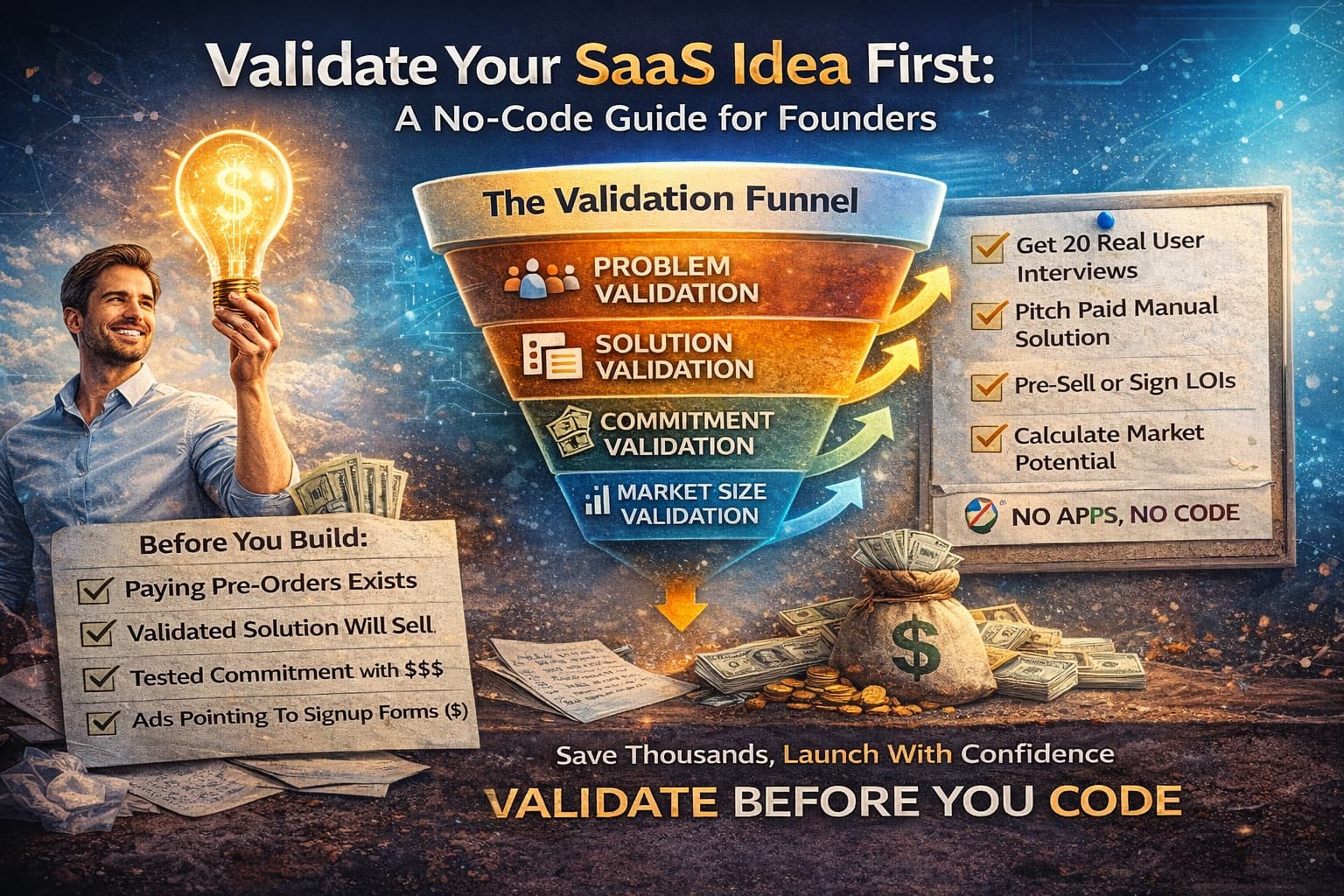
Validate Your SaaS Idea First: A No-Code Guide for Founders
You've got the idea. It's brilliant. You've already named the company, checked domain availability, and imagined your TechCrunch feature. The only thing standing between you and unicorn status is... well, actually building the thing.
So you hire a developer. Or learn to code. Or find that technical co-founder who'll work for equity. Six months and $15,000 later, you launch. And crickets. Maybe 50 signups. Three paying customers. A whole lot of "great idea, but not for us."
Here's the painful truth: You built something nobody actually wanted. And you could have known that for free, before you spent a dime on development.
At Ark Services, we've seen too many founders skip SaaS idea validation and jump straight to building. They confuse enthusiasm with product-market fit. They mistake their own frustration for universal demand. And they learn the expensive way that "if you build it, they will come" is a movie quote, not a business strategy.
But here's the good news: You can validate your SaaS idea without writing a single line of code. No prototypes. No landing page builders. No fake "coming soon" buttons. Just smart, fast experiments that tell you whether you're solving a real problem for real people who will really pay.
Let me show you exactly how.
The "Solution Looking for a Problem" Trap
Most failed SaaS ideas don't start with market research. They start with a shower thought. "Wouldn't it be cool if..." or "I hate how current tools do X" or "There's got to be a better way to..."
And those instincts can be valuable. But they're hypotheses, not facts. They're starting points, not destinations.
I talked to a founder last month who spent $12,000 building an automated invoicing tool for freelancers. Beautiful design. Solid code. Launched to... 200 users in three months. Why? Because freelancers don't actually hate invoicing enough to pay for another tool. It's annoying, sure. But they're already using three other apps, and switching costs are high.
He could have discovered this with a $50 Facebook ad test and a Typeform. Instead, he discovered it with a failed product.
Here's the thing: Your pain isn't necessarily a market. Your problem might be yours alone. Or it might be real, but not painful enough to justify a new subscription. Or the people who have it might not be the people you think.
SaaS idea validation is about killing your darlings before they cost you everything. It's about finding out you're wrong fast, cheap, and without emotional attachment to a codebase.
The Validation Framework That Actually Works
Forget the "build a landing page and see if people sign up" advice. That's validation theater—collecting emails from curious people who'll never convert. Real validation requires harder tests.
At Ark Services, we use a four-step framework with every founder who comes to us with "the next big thing."
Step 1: Problem Validation (Week 1)
Before you build anything, prove the problem exists and hurts. This isn't about your idea—it's about their pain.
Find 20 people who fit your target customer profile. Not friends. Not your mom. Real potential users. Interview them. Ask about their current workflow. Where does it break? What workarounds have they tried? What would they pay to make it disappear?
You're not pitching. You're listening. If you find yourself explaining your solution, you're doing it wrong.
Red flag: They say "that sounds interesting" but can't describe their current pain in specifics. Interest isn't demand. "Interesting" doesn't pay subscription fees.
Green flag: They vent. They show you their messy spreadsheets. They describe workarounds that waste hours. They use words like "frustrating," "nightmare," or "I would literally pay for this to go away."
Step 2: Solution Validation (Week 2)
Now you describe your solution. Not with code—with words. A detailed explanation of how it would work. Maybe a simple diagram. The "Wizard of Oz" approach: pretend the tech exists, manually deliver the result.
Example: A founder wanted to build AI-powered content suggestions for marketers. Instead of building the AI, she offered to manually research and send weekly content ideas to 5 beta testers for $50/month. Three signed up. She validated that marketers would pay for curated content before she spent a penny on machine learning.
If people won't pay for the manual version, they won't pay for the automated one. Automation adds convenience, not value.
Step 3: Commitment Validation (Week 3)
This is where most validation fails. Free interest is abundant. Actual commitment is rare.
Get pre-orders. Or letters of intent from businesses. Or signed contracts with deposit checks. Something that requires your prospect to take action that costs them something—money, time, reputation.
One founder I know got 500 email signups for his "revolutionary project management tool." Felt great. Then he offered early access for $99/year. Three people bought. Those 500 signups meant nothing. The three buyers meant everything.
Step 4: Market Size Validation (Week 4)
Can you reach enough of these people profitably? A problem shared by 1,000 people who'll pay $50/month is a $50k/year business. That's a lifestyle business, not a venture-scale SaaS. Know which you're building.
Calculate: How many potential customers exist? How much will they pay? How much does it cost to acquire one? If customer acquisition cost exceeds lifetime value, you don't have a business. You have a charity.
Real Validation Tactics (That Cost Under $100)
You don't need a dev team to validate. You need creativity and hustle.
The Concierge MVP
Manually do the work your software would do. A founder wanted to build automated social media analytics. Instead, she offered to manually compile weekly reports for 10 agencies at $200/month. Five signed up. She learned exactly what metrics mattered, what format they wanted, and how much they'd pay—before building anything.
After three months, she knew exactly what to automate. Her SaaS launched with paying customers already using the manual version.
The Fake Door Test
Create a landing page describing your solution with a "Buy Now" button. When clicked, it says "Coming soon—join the waitlist." Track click-through rates. If less than 5% of visitors click "Buy," you don't have product-market fit. You have curiosity.
One important caveat: This works for B2B SaaS, not consumer apps. Consumers click out of impulse. Business buyers click because they have budget and authority.
The Peer Validation Method
Post in communities where your target customers hang out. Not "I'm building X, what do you think?" That's begging for validation. Instead: "How do you currently handle [problem]? What tools do you use? What's the worst part?"
If 50 people respond with detailed complaints, you've got something. If you get crickets or generic "sounds cool" comments, you don't.
The Competitive Analysis Reality Check
If no competitors exist, that's usually a bad sign. Not because you can't be first—because it probably means there's no market. Or the market is tiny. Or the problem is unsolvable profitably.
Healthy markets have competition. Your job isn't to find an empty space. It's to find a crowded space where everyone hates the current solutions.
Red Flags Your "Validation" is Actually Vanity
Founders love to feel validated. So they design tests that confirm their biases. Watch for these traps:
"People said they'd use it"
Saying and doing are different. People are nice. They'll encourage your dreams. That doesn't mean they'll enter credit card details.
"I got 1,000 email signups"
Email addresses are free. They're the digital equivalent of "let's grab coffee sometime." Means nothing until money changes hands.
"My friends love it"
Your friends want you to succeed. They also don't want to hurt your feelings. And they're not your target market unless your SaaS is "gifts for founders' friends."
"Big companies said it's interesting"
Enterprise "interest" is not commitment. They've got budgets for innovation theater. Actual procurement requires 18 months and 47 meetings. Don't count that chicken before it hatches.
"No one else is doing this"
See above. This is usually a warning, not an opportunity. The world isn't full of undiscovered billion-dollar ideas waiting for you to find them.
When to Actually Start Building
So when do you stop validating and start coding? When you have:
- 10+ pre-orders or paid commitments from strangers (not your network)
- Clear understanding of the exact problem you're solving
- Pricing validation—people have agreed to specific numbers
- Distribution plan—you know how to reach 1,000 more just like them
- Differentiation—you know why they'll switch from current solutions
At Ark Services, we won't start custom development until we see these signals. Not because we're difficult, but because we've seen what happens when we don't. Building on speculation is gambling. Building on validation is investing.
The Bottom Line
Your idea is probably wrong. Not because you're not smart—because everyone’s first idea is wrong. The founders who win aren't the ones with perfect initial ideas. They're the ones who find out they're wrong fast, cheap, and without a codebase to mourn.
SaaS idea validation isn't about proving you're right. It's about proving you're not wrong before you spend your savings. It's about discovering that your "brilliant" idea is actually a feature of someone else's product, or that your target market is 400 people total, or that people would pay—but not enough to sustain a business.
These discoveries feel like failures. They're actually victories. They save you from the real failure: building something nobody wants and finding out too late.
What's your current SaaS idea? Have you actually validated it with real potential customers, or are you still in the "everyone I describe it to thinks it's cool" phase? Drop it in the comments—we'll give you an honest gut check on whether you're ready to build or still need to test. And if you want to build only after you've proven the market, you know where to find us.
Comments
Join the discussion