React Native vs Native Android: Our 2026 Startup Guide
Building an Android app in 2026? We break down React Native vs Native Android costs, speed, and maintenance so non-technical founders can choose smart.
React Native vs Native Android: Our 2026 Startup Guide
You’ve got the wireframes. You’ve got the investor meeting next month. And you’ve got a developer on Zoom telling you that you absolutely need Kotlin and a separate iOS team while you’re still Googling “what is React Native.”
Take a breath.
If you’re a non-technical founder trying to decide between React Native vs Native Android, you’re probably drowning in conflicting advice. Your CTO friend swears native is the only way. That offshore agency keeps pushing “hybrid apps” because they’re cheaper. And you? You just want something that works without burning through your runway.
Here’s the thing—we’ve built both. We’ve seen startups ship beautiful apps in eight weeks using React Native. We’ve also watched founders spend six months and $40k on native Android code they eventually scrapped because they needed iOS too.
So let’s cut through the noise. No jargon. No bias. Just what actually matters for your budget, your timeline, and your sanity in 2026.
What the Heck is the Difference?
Before you spend a dime, you need to know what you’re actually buying. Think of it like building a house.
Native Android development is like constructing two completely separate houses—one for Android users, one for iOS users. You need two construction crews (Kotlin/Java for Android, Swift for iOS), two sets of blueprints, and twice the materials. But each house is perfectly optimized for its specific neighborhood.
React Native is like building one modular house that magically works in both neighborhoods. One crew, one timeline, shared materials. It’s cross platform app development at its core—write code once, deploy to both Android and iOS.
The trade-off? Sometimes the modular house has quirky plumbing. It might not use every fancy feature of the neighborhood quite as smoothly as a custom-built home. But it’s finished in half the time and costs significantly less.
And honestly? For most startup MVPs, that trade-off is a no-brainer.
The Cost Reality Check (Because Your Budget is Staring at You)
Let’s talk numbers since that’s what’s keeping you up at night. In 2026, mobile app development cost is still the biggest killer of early-stage startups.
Native Android development requires specialized developers. Good Kotlin developers in the US charge $100-150 per hour. Need iOS too? Double that team. A basic native app for both platforms easily runs $60k-100k before you even launch.
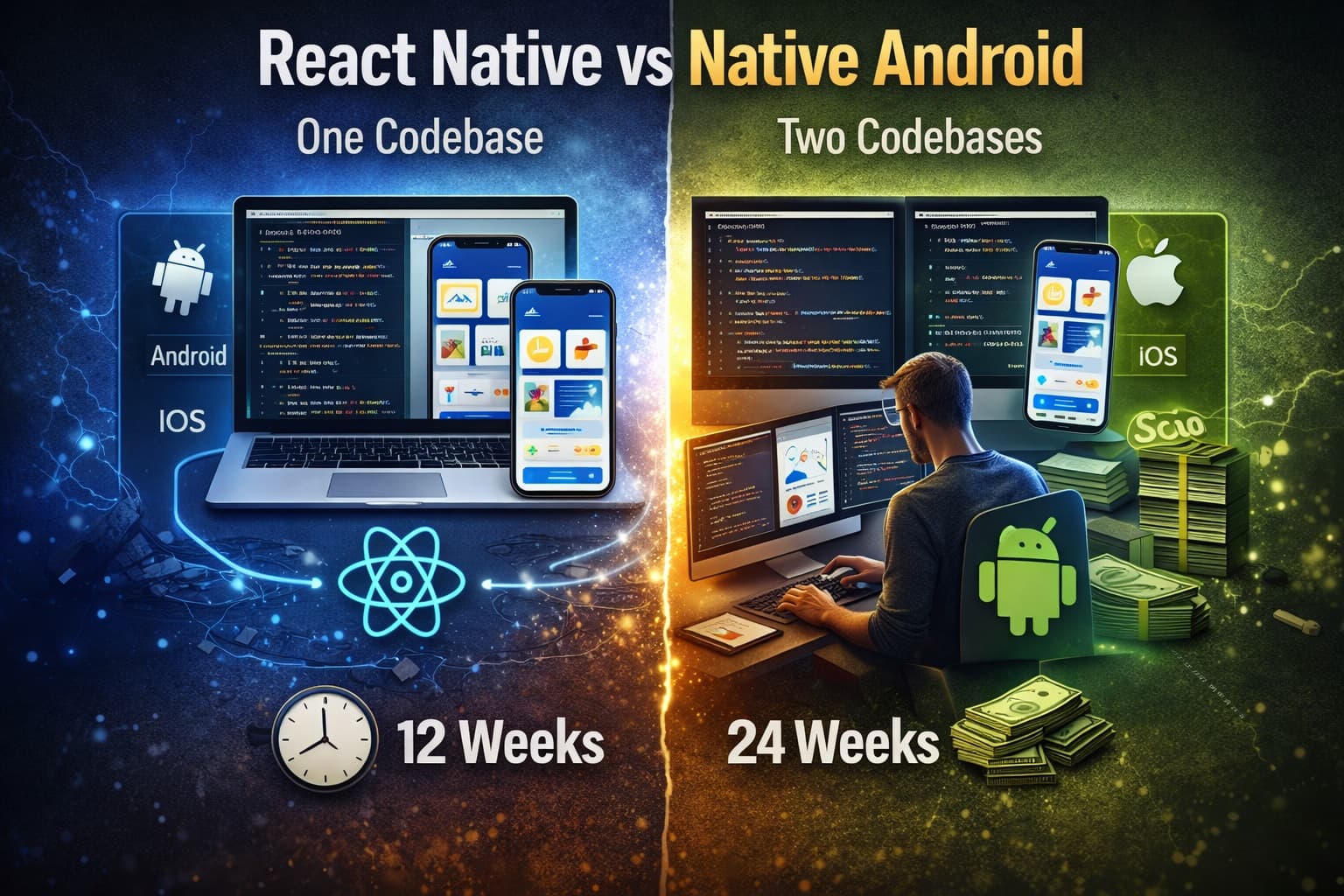
React Native changes the math completely. One codebase means one team. One timeline means you’re paying for 600-800 hours instead of 1,200-1,600. We’ve shipped solid MVPs for startups in the $15k-25k range using cross platform app development.
But wait—it gets better. Maintenance is where native really hurts. When Android pushes an update (which they do constantly), your native Android team fixes it. When iOS updates? Different team, different fixes, double the invoices. With React Native, updates happen once, apply everywhere.
One founder told us she budgeted $5k per month for native app maintenance. After switching to React Native, she’s spending $1,200. That’s $45,000 saved in her first year alone. That’s runway. That’s marketing budget. That’s survival.
Speed to Market: Who Actually Wins?
You’ve heard “fail fast” a million times. But nobody tells you that the tech stack you pick determines how fast you fail—or succeed.
Native development is slow. Painfully slow. Two separate codebases means every feature gets built twice. Found a bug? Fix it twice. Want to A/B test a button color? Deploy twice. You’re looking at 4-6 months minimum to hit both app stores.
React Native cuts that in half. We’re talking 8-12 weeks for an MVP that works on both iOS and Android. In startup time, that’s the difference between catching the wave and watching it crash on someone else’s beach.
And here’s something that surprised even us: React Native has gotten really fast in 2026. The new architecture improvements mean most users can’t tell the difference between a hybrid app and a native one. Unless you’re building the next TikTok with heavy video processing, your users won’t care—they’ll just appreciate that your app actually exists when your competitors are still in development hell.
When Native Android Actually Makes Sense (Yes, Really)
I’d be lying if I said React Native is always the answer. It’s not. And if a developer tells you it is, they’re probably just trying to make their own life easier.
Choose Native Android development when:
- You’re building something hardware-intensive (think AR/VR, complex gaming, or apps that need deep camera control)
- You need to access every single Android feature the second Google releases it
- Performance is literally everything (like a high-frequency trading app)
- You have Facebook’s budget and can afford two elite dev teams
But let’s be honest—if you’re reading this, you probably don’t fit those categories. You’re building a marketplace app. Or a SaaS companion tool. Or a delivery tracking system. You need solid, reliable, good-looking software—not a technical masterpiece that takes a year to ship.
The Maintenance Nightmare Nobody Talks About
Here’s where founders get burned. They look at the initial quote and think that’s the total cost. Spoiler: it’s not even close.
Native apps are like owning two cars instead of one. Twice the oil changes. Twice the flat tires. Twice the registration fees. When Android 16 drops next year (and it will), your native app needs immediate attention. Same with iOS updates. You’re constantly juggling two codebases, two testing cycles, two deployment pipelines.
React Native isn’t maintenance-free—nothing is—but it’s maintenance-manageable. One update fixes both platforms. One bug fix applies everywhere. Your single developer (or small team) can handle it without needing specialized experts for each operating system.
And in 2026, the ecosystem has matured massively. Those scary stories from 2020 about React Native breaking with every update? Ancient history. Facebook, Instagram, and Shopify have poured millions into stabilizing the framework. It’s enterprise-ready now, not just hobbyist-ready.
Our 2026 Recommendation for Startups (Days 1-7 Edition)
So what do we actually tell our clients when they walk in with a brilliant idea and a tight budget?
Start with React Native. Period.
Unless you’re building something that absolutely requires native performance, cross platform app development gives you everything you need: faster launches, lower costs, and the ability to pivot quickly when your users inevitably tell you they want something different.
Here’s the actionable part—how to make sure you do this right:
Validate first, polish later. Build your MVP in React Native to test the market. If you hit product-market fit and need to optimize performance later, you can always rewrite specific screens natively. But don’t optimize for scale you don’t have yet.
Hire generalists, not specialists. Look for React Native developers who understand both platforms broadly rather than Android purists who look down on hybrid code. You want business-minded builders, not tech purists.
Plan for the app stores. Both Google Play and the App Store have gotten stricter in 2026 about review guidelines. React Native apps sail through reviews just fine, but make sure your developer understands the submission process for both platforms simultaneously.
Think about your runway. Every dollar you save on development is a dollar you can spend on customer acquisition. In the early days, speed and budget matter more than perfect frame rates.
The Bottom Line
React Native vs Native Android isn’t a religious war—it’s a business decision. And in 2026, for startups in Days 1-7 who need to ship fast and learn faster, React Native is the smart money.
You don’t need perfect code. You need working code that gets you to your next milestone without emptying your bank account. You need to test your assumptions before you’re $80k in the hole. You need to sleep at night knowing one platform update won’t bankrupt you.
Native development has its place. It’s beautiful, powerful, and necessary for certain applications. But for most startup MVPs? It’s overkill. It’s buying a Ferrari to learn how to drive.
What’s your biggest worry about choosing the wrong tech stack for your app? Are you leaning toward React Native, or does native still feel safer? Drop a comment—we read every one, and we’ll give you straight answers without the developer ego.
Comments
Join the discussion